|
|
Handhaben |
|
|
|
|
||||||||||||||||||
| Die
Prüf- und Sortieranlage ist in drei Maschinenteile: Prüfsystem,
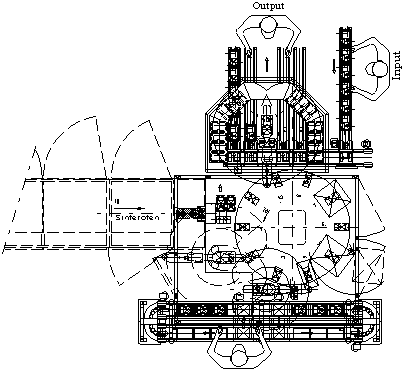
Puffersystem und Sortiersystem gegliedert. Zentraler Bestandteil des Prüfsystems ist ein Rundschaltteller mit 10 Stationen. Diese Stationen nehmen jeweils eine Solarzelle durch einen speziellen Klemmmechanismus auf. Die erste Station wird durch einen Roboter beladen. Dieser entnimmt die Zellen vom laufenden Auslaufband des Einbrennofens und positioniert sie über einer Kamera. Durch diese wird die Lage der Zelle ermittelt. Hier erfolgt auch bereits die erste Prüfung auf Kantenausbrüche. Die beiden nachfolgenden Station des Drehtellers ermöglichen dem Roboter des Puffersystems den Zugriff auf die Zellen. Dieser ist mit einem Speicher für 1200 Solarzellen ausgerüstet. Wenn am Auslauf des Ofens nicht innerhalb eines definierten Zeitfensters eine Zelle ankommt, wird automatisch durch den Pufferroboter eine Zelle aus dem Puffer entnommen und in den Teller eingelegt. Falls der Sortierroboter nicht zur Entnahme von Zellen bereit ist, entnimmt der Pufferroboter die Zelle. An der ersten Prüfstation wird die Zelle auf Ebenheit und Dicke geprüft, dazu werden mehrer Lasertriangulationssensoren oberhalb und unterhalb der Zelle positioniert. Die optische Prüfung der Zellenoberseite erfolgt an der nächsten Station. Zwei nebeneinander angeordnete CCD Kameras werden über der Zelle verfahren und mehrere Detailbilder aufgenommen. Es wird die Struktur auf der Zelloberseite auf Unterbrechungen und Unregelmäßigkeiten geprüft, sowie wichtige Abstandsmaße ermittelt. An der nächsten Prüfstation wird die Zelle von unten und oben kontaktiert. Während der Bestrahlung mit einem sonnenähnlichen Licht wird der erzeugte Strom gemessen. Dieser ist ein Maß für den Wirkungsgrad. Die letzte Prüfung im Rundschaltteller ist eine Crack-Detect Prüfung. Hier können feinste Risse, welche später zum Bruch der Zelle führen würden, erkannt werden. Nach dieser Prüfung entnimmt der Roboter der Sortieranlage die Zelle aus dem Rundschaltteller und positioniert die Zelle über einer Kamera, welche von unten auf die Zelle schaut. Es wird der Flächenbedeckungsgrad der aufgebrachten Rückseitenmetallisierung durch ein Visionsystem ermittelt. Zusätzlich werden die Positionen der Kontaktierstellen vermessen. Der Roboter legt die Zelle unmittelbar nach der Auswertung der Daten in einen von 14 Stapelbehältern ab. Die einzelnen Prüfergebnisse können miteinander kombiniert werden um die Zuordnung zu den Klassen zu bilden.
|
The
inspection and sorting plant comprises three main machine sections: The
testing and inspection system, the buffer system and the sorting system.
The testing and inspection system centres on an indexing table fitted with 10 stations. Each station accommodates a solar cell using a special clamping mechanism. The first station is loaded by a robot. This removes the cells from the continuously running outfeed conveyor belt of the stoving furnace and positions them over a camera which determines the position of the cell. At this point, the first inspection for chipping at the edges takes place. The two downstream stations of the indexing table permit access to the cells by the robot assigned to the buffering system. This buffer is equipped with storage facility for 1200 solar cells. If a cell fails to arrive at the furnace outfeed within a certain defined time window, a cell is automatically removed from the buffer by the buffer robot and inserted in the table. If the sorting robot is not ready to remove cells, the buffer robot steps in to engage the next cell. At the first testing and inspection station, the cells are tested for flatness and thickness. For this purpose, several laser triangulation sensors are positioned above and below the cell. Optical inspection of the upper cell surface takes place at the next station. Two adjacent CCD cameras travel over the cell and take several detailed images. The structure on the upper cell surface is inspected for interruptions and irregularities and important distance measurements are taken. At the next testing and inspection station, the cell is contacted from above and below. During irradiation with light approximately equivalent to sunlight, the generated power is measured. This provides a measurement for the degree of efficiency. The last test performed in the indexing plate is a crack detection test. Here, even the finest cracks which could lead to subsequent cell breakage are detected. Following this inspection, the sorting plant robot removes the cells from the indexing plate and positions the cells above a camera which views the cells from below. The degree of surface coverage of the metallizing layer applied to the back of the cells is detected using a vision system. In addition, the positions of the contacting points are also gauged. The robot positions the cells directly after evaluating the acquired data in one of 14 stacking containers. The individual test results can be combined in order to generate a value permitting classification.
|
|||||||||||||||||
|
|
||||||||||||||||||
|
|
|
Startseite
–
Die Firma
–
Kontakt |