|
|
Bestücken |
|
|
|
|
||||||||||||||||||
|
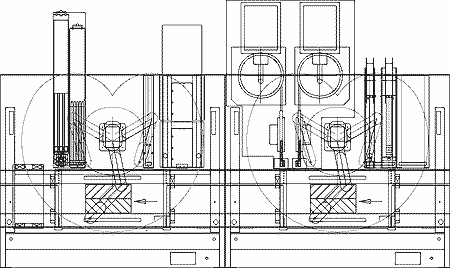
Die Anlage besteht
aus zwei unabhängigen Bestückungszellen. Zwischen den
Bestückstationen besteht ein Puffer von je zwei Leiterplatten. Die
Bestückungszellen sind Standard-Roboterzellen, die mit zwei 6-fach
Revolvergreifern ausgerüstet sind. Die Leiterplatten werden als Nutzen
automatisch von einer vorgelagerten Station übernommen und nach der
Bestückung auf eine nachfolgende Station übergeben. Am Einlauf der
Linie werden die Leiterplatten mit einem stationären Barcodeleser
kontrolliert. Mit einem Handbarcodeleser werden die Zuordnungen der
Bauteile zu den einzelnen Zuführungen überprüft. Die Bauteilbeinchen,
der zu clinchenden Teile, werden an beiden Stationen während der
Bestückung durch ein Clinchwerkzeug unter der Leiterplatte umgebogen.
Die Bestückung der Bauteile wird an beiden Stationen durch eine
Setzkraftkontrolle überwacht.
|
The
unit comprises two independently operating pick and place cells. There
is a buffer of two circuit boards at any one time between the pick and
place stations. The pick and place cells are standard robot cells
equipped with two 6-head turret grippers. The circuit boards are
automatically transported from an upstream station in the form of panels,
and conveyed to a downstream station after completion of the pick and
place process. The circuit boards are monitored by a stationary bar code
reader at the line infeed, and assignment of the components to the
individual feed stations is checked using hand-held bar code readers.
The component pins are bent over and clinched underneath the board at
both stations during the pick and place process by means of a clinching
tool. Component placement is monitored at the two stations by means of a
setting force control system. At the first robot station, a turret
gripper is used to mount transformers fed in pallets and radially belted
components for circuit board type 1. For circuit board type 2, the
radial feeders have to be exchanged for an axial feeder and different
radial feeders. The pallet feed method is exchanged for two vibratory
hopper conveyors mounted on a base plate. The feed systems are
electrically and pneumatically connected to the unit by means of plug-in
connections and clamped on the machine table using a quick-action
locking system. At the second robot station, loudspeakers, buzzers,
radial components and stepping motors are mounted for circuit board type
1. Loudspeakers and buzzers are fed using stick feeders, the step motors
by means of a pallet changer. In order to further enhance system
autonomy, a pallet lift is used to feed the stepping motors. At the
third circuit board station, the board is raised from below out of the
belt and pressed against a holding-down plate. During the press-in
process, all the connecting pins of the stepping motors are scanned by
means of back-pressure sensors. |
|||||||||||||||||
|
|
||||||||||||||||||
|
|
|
Startseite
–
Die Firma
–
Kontakt |