|
|
|
|
Flexible automation of electronic production processes Once
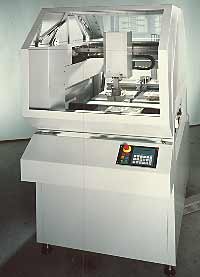
the SMD´s are placed, what next? Most planners of production lines for electronic or electromechanical units and assemblies are faced by this difficult problem. Given the high degree of component and component packaging standardization, automation up to the SMD assembly stage has since become relatively simple to implement. Suitable machine concepts are also available for highly flexible production lines. This unfortunately does not apply to the downstream process steps. For odd component placement, selective soldering, division of panels and unit mounting, individual solutions do exist, but consistent and comprehensive concepts are far more difficult to implement. As a result, planners frequently opt for manual placement and assembly as the more flexible, reliable and economical alternative. Manz Automatisierungstechnik GmbH from Reutlingen in Southern Germany aims to close this gap by offering consistent concepts for the automation of post-SMD assembly processes. The MANZ inLine modules for flexible automation of electronic production processes form the basis for this type of solution. MANZ inLine modules are highly flexible basic machines featuring standardized interfaces permitting optimized material flow and customer data networking. The basic machine FAM-1 is fitted with a 4-axis linear robot. With a width of only 990 mm, this machine can be simply integrated into even the most cramped of production lines.
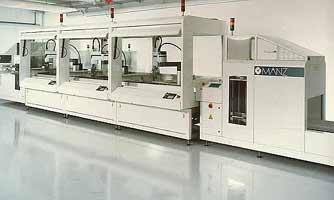
The basic machine FAM-2 is 1980 mm wide. This machine is fitted with a 4-axis SCARA robot and is used wherever more space is required for component feed, for example in large deep-drawn pallets. Both machines can be either integrated into production lines or operated offline as production islands, and are equipped as standard with a SMEMA or Siemens interface for material flow. Internal interfaces for the various transport systems for PCBs or workpiece carriers, for grippers and for component feed units are both mechanically and electrically standardized, so permitting the rapid implementation of complete production lines. But most importantly, the high degree of standardization substantially enhances the conversion flexibility of this type of line. The input required to adjust an automated production line to cope with product changes or alterations in volume is thus drastically reduced. This mechanical flexibility is supported by a modern, efficient control concept. Each cell has its own PC control system and can be optionally fitted with a user interface based on Windows NT. A database integrated in the cell control system is used to store type-specific data as well as machine and quality-related data. Due to use of the Windows standard, this database is capable of simple communication with databases on one or more central servers. This concept permits extremely simple integration of the equipment into the customer's existing data structure. Standardized interfaces such as RS 232 or TCP/IP are already integrated into the basic machine. The units are operated using a touchscreen in the customary Windows environment. Application-specific windows permit reliable, simple input and editing of process parameters, also during running operation. The control system features a further important highlight: full integration of Cognex Vision Systems. Offering precision levels up to 1/40 pixel, these systems currently represent the cutting edge of technological development in the field of position determination and gauging. The various applications designed for the automation of electronic production processes are implemented of the basis of this tried and tested machine type. In particular in the field of odd component placement, automatic assembly, automatic final inspection and packaging, the specialists at Manz are able to draw on an impressive pool of expertise. For processes calling for highly specialized knowledge, such as selective soldering or electronic testing, Manz works in close cooperation with specialists from the respective fields. Within the scope of overall projects, these processes are integrated into production lines supplied by Manz.
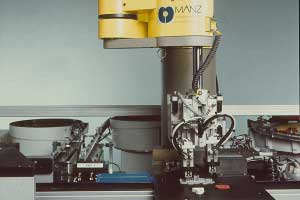
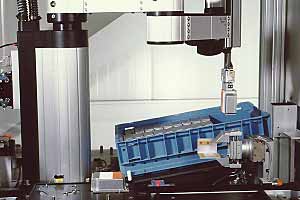
Odd component placement constitutes one of Manz's key areas of competence. In a whole range of applications, these systems have proven that odd component placement represents a viable alternative to manual assembly. Both process reliability and system availability have been substantially improved over recent years. For the automatic placement of odd components, depending on the required feeders and the necessary cycle time, either the large or small basic machine is used. There are many applications in which a hybrid structure encompassing different modules can also offer a sensible alternative. For component feed, one of the most complex problem areas of all in the field of odd component placement, a wide range of different feeder systems are available. For feed of components from axial or radial belts, from sticks, pallets or loose stock, standardized modules are available in a variety of configurations. However, special solutions for feeding complex contact elements from the blanking belt or of 200 µm thick copper foil pieces do not represent an unsurmountable problem for the engineers at Manz. It is just this ability to solve individual customer problems quickly, reliably and economically which sets Manz apart. Particular emphasis is attached to the all-important close contact with customers during the project processing and design phase. In many cases, economical, technically sensible component feed solutions can only be developed in close cooperation between the machine manufacturer, customer and component supplier. A similar situation applies to gripper technology. Alongside standardized applications, special solutions are often called for here in order to permit the safe, reliable placement of complex components. The use of extensive sensory systems in the gripper heads permits a high degree of placement reliability to be ensured, so enhancing product quality. In the field of clinching tools too, alongside standard solutions such as Manz's own semi-active clinching tool with type-specific clinch plates or the flexible freely programmable 4-axis clinching tool, non-standard solutions are often required to solve the highly specific application requirements of certain customers. For the final assembly of units and modules, the same basic machines are used as for odd component placement. Instead of carrier-less PCB transport systems, in this case workpiece carrier transport systems are used. By using freely programmable robot systems, it is possible to implement highly flexible assemble systems for this application. The gripper technology and feed systems are frequently identical or very similar to those used for odd component placement, and further-reaching processes such as press-in, greasing, screwing, gluing, soldering or laser welding can also be simply integrated into the basic machines. By integrating inspection steps into the various assembly processes, it is possible to safeguard product quality as early as the assembly stage.
Inspections for completeness and dimensional stability using vision systems are just as much part of the standard package as the force-stroke testing of spring elements or electrical performance testing of sub-assemblies already during the assembly process. If the automation process is carried through to its logical conclusion, assembly is followed by automated final inspection, marking and packaging of assembled units. This type of plant encompasses a wide range of testing and inspection facilities integrated into the overall production line, starting from in-circuit testing through electrical performance checks to testing under different environmental influences in the climatic cabinet. The simple facility for coupling the control system to the customer's computer system forms a particularly important criterion in this type of plant. In many cases, the test data is transmitted to higher-level CAQ systems or, when working with safety-relevant assemblies such as airbag control units, saved in databases relative to specific individual units. Marking of assemblies using a wide range of different methods such as laser inscription, ink jet inscription or labeling forms another constituent of a fully automatic line. A range of standardized, tried and tested modules are available for this purpose.
Testing and identification are followed by the last step, fully automatic packaging of the finished units. Here too, the use of robots can substantially enhance flexibility and reliability. A wide range of different solutions for packaging in deep-drawn trays, transport crates or cardboard boxes has already been implemented and can be simply integrated into the basic machines. Fully automatic, reliable segregation of bad parts generally forms a constituent component of packaging plants, and helps to ensure the high quality of deliveries to the end user. Using the described technology, not only it is possible to implement solutions for comprehensive automation from the odd shape assembly process right through to packaging, but to do so with outstanding economy due to the high degree of standardization offered by the MANZ inLine module, coupled with the company's extensive fund of process engineering know-how.
|
|
|
|
|
homepage
–
the
company –
contact
|